

Building Our Missing Care Infrastructure: Elevate's New "Coop of Coops"
How the ICA Group is helping home care businesses become viable while delivering quality care

When big financial interests buy up a local software company, its own employees may feel the change but its home community will likely not even notice.
Not so with businesses providing social care—child care, elder care, disabled care. When these small enterprises are bought up—often in multiples—by large holding companies, suddenly employees find themselves tied to an app and new work procedures. The result usually forces them to lower care quality standards which can impact their clients adversely.
Home care is a sector of social care under tremendous pressures—in terms of job quality, low wages, low worker retention rates, and so on.
In the U.S., an estimated 30,000 home care agencies operate today, of which 11,500 are Medicare-certified. These numbers are far lower than what’s needed but setting up a home care business has not been simple.
Here’s a whole page of stats that will give you a picture of the situation—which is pretty dire.
Addressing these issues effectively could mean transforming the work lives of home care workers. In the ICA Group’s business incubation program, these workers find themselves in a different world—receiving living wages in democratic workplaces that are employee-owned.
The ICA Group, based in Northhampton MA, is a leading expert on worker ownership and the oldest national organization dedicated to the development of worker cooperatives.
Their vision is to create (and convert) home care cooperatives where workers will enjoy improved working conditions through better training, higher wages, and job supports. The result: increased worker satisfaction, decreased turn over, and ultimately higher quality, consistent care for care recipients.
In countries like Italy, Quebec, or South Korea, this incubation process is greatly facilitated by the existence of support networks which are themselves “secondary cooperatives”—i.e., co-ops comprised of co-ops.
This is a critical piece of support infrastructure that has been almost entirely missing in this country. Until now.
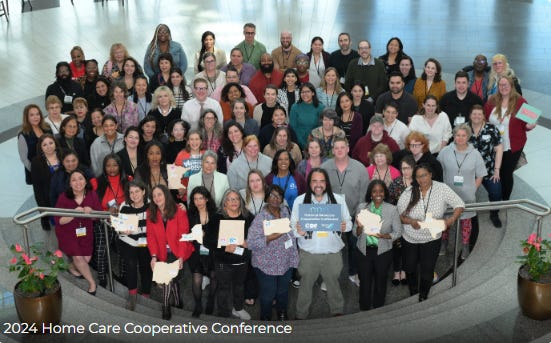
After several years in development, the ICA Group recently announced the launch of Elevate Cooperative, a national network and membership organization designed by and for caregiver-owned home care agencies. It aims to strengthen, scale, and unite home care cooperatives to build quality jobs and improve the lives of caregivers.
Elevate already has 13 member organizations employing over 1,500 caregivers in 11 states. Their membership categories include 1) operating home care co-ops; 2) startup home care co-ops; and 3) co-op developers, workers centers and community organizations.
Service for member co-ops include:
business strategy and growth coaching
growth capital
education, training, professional development
group purchasing (including software systems) and back office optimization
peer networking and information exchange
affordable employee benefits (healthcare, etc.)
policy advocacy and public education
One newly-launched member organization of Elevate is the Colorado Care Cooperative (CCC), a state-wide initiative incubated by the Rocky Mountain Employee Ownership Center.
After years of gathering data and talking to stakeholders, Colorado’s first homecare coop is preparing to launch their community-driven services in the Front Range, Western Slope, and Southern Colorado as they await approval of their Class A Medical Home Care Agency license.
Recently, Debra Brown, the RMEOC’s program director for the CCC, did a presentation about their work which you can view here.
I imagine that healthcare and home care workers would like to cut out as much large corporate interference with good quality care as possible. When I taught, I switched schools twice and jurisdictions once to get away from administrative and bureaucratic policies and bloat that interfered with my exercise of professional judgment. Being able to stay in touch with one’s vocation during the workday turned out to more valuable to me than other perquisites that big jurisdictions or corporations might offer.